Request a demo
Fill out the form and
we’ll be in contact shortly


Many buildings have a fire safety capacity of 800 or more, but rarely come near to filling it. That gap counts since it can determine your tier under Martyn’s Law. Here’s where evidence becomes particularly valuable. If your actual peak headcount is below 800, you may belong in the standard tier, with fewer obligations and lower penalties. However, you must be able to explain your assessment to the regulator if they request it.
This guide explains the two tiers under Martyn’s Law, what counts as acceptable evidence, and how occupancy sensors can give you a reliable record of your real peak headcount.
Martyn's Law is the common name for the Terrorism (Protection of Premises) Act 2025. It is named after Martyn Hett, one of 22 people killed in the Manchester Arena attack in 2017. His mother, Figen Murray, campaigned for the law.
The Act requires certain public premises and events to be prepared for a terrorist attack.
Key facts:
Martyn's Law applies to premises and events that meet all four conditions in section 2 of the law:
Events are assessed separately. A public event is in scope if 800 or more people may be present at the same time and entry is checked ( e.g., ticket or pass checks).
Schedule 1 of the Act lists the following 17 categories of use:
A building can be partly in scope. A shop inside a factory, or each unit in a shopping centre, can count as qualifying premises on its own. Therefore, you should only include the people counted in the part of the building used for a Schedule 1 purpose.
If the premise is an organisation, the person responsible for ensuring compliance must be either a manager or a person in control of the organisation.
Schedule 2 of Martyn's law excludes the following premises:
The Act splits premises into two tiers, depending on how many people you can reasonably expect to be present at the same time, staff included. Premises that belong to the following categories stay in the standard tier regardless of how many people they expect:
Your tier depends on the maximum number of people you can reasonably expect to be present at the same time, from time to time.
The Home Office's Supplementary Document A sets out six acceptable methods that can help you determine your tier. It says they "allow for flexibility and judgement":
You must also keep in mind that:
The SIA can ask how you carried out your assessment, and regardless of the method you choose, you need to be able to show your working.
A premise with a fire capacity of 800 can use that figure and end up in the enhanced tier. However, for many organisations, that would be a costly overstatement since the enhanced tier comes with additional duties and higher penalties, including:
The opposite mistake is just as risky. Claiming the standard tier without evidence leaves you exposed if the SIA asks how you reached your figure. Guesswork, or a single head count on a quiet day, will not hold up.
Therefore, the answer is an accurate assessment that reflects your real peaks and is backed by data you can show.
Premises belonging to the standard tier must meet the following requirements:
The standard tier does not require public protection measures, a compliance document, or a designated senior individual.
Occupancy sensors turn your peak headcount from an estimate into a measured record that supports the "historic attendance data" method in the Home Office guidance, which values data that reflects "actual usage at peak times".
The guidance doesn't name sensors, but it points their way. One of its own examples has an operator keeping "an hourly count of visitors" and measuring how long they stay. Another example has a nightclub tracking numbers with a clicker at the door. Sensors do the same job automatically, around the clock, and keep the record.
Occupancy is not the same as footfall.
The Act counts people present at the same time. A footfall counter that records 3,000 entries a day tells you little on its own. What you need are occupancy sensors that can:
The following steps will help you build a reliable evidence file for the authorities:
Sensor data is evidence, not a loophole.
If your data shows peaks close to 800, consider managing them. Timed entry, booking systems, or a lower limit can keep numbers below the threshold.
Does my fire safety capacity decide my Martyn's Law tier?
Not on its own. The test is how many people you can reasonably expect to be present at the same time. Fire capacity is one of six methods the Home Office lists for estimating that.
Do staff count towards the 200 and 800 thresholds?
Yes. The figure must include employees, contractors, and volunteers in the parts of the premises used for a Schedule 1 purpose.
My building is usually under 800, but busier at Christmas. Which tier am I in?
If you can reasonably expect 800 or more at those times, you are in the enhanced tier. "From time to time" means occasionally, not on average.
What if we passed 800 once, unexpectedly?
A one-off surge you could not reasonably have anticipated, and don't expect again, does not, on its own, move you into the enhanced tier. Record what happened.
Can occupancy sensor data be used as evidence?
The guidance doesn't name sensors, but it accepts historic attendance data that reflects actual peak usage. Accurate, timestamped occupancy sensor records are a strong way to provide it.
How long should we collect data for?
No period is set. Twelve months is a sensible target, because it captures seasonal peaks.
When does Martyn's Law come into force?
The implementation period is at least 24 months from Royal Assent on 3 April 2025. According to the Security Industry Authority, the Act is expected to come into force in spring 2027.
Does Martyn's Law apply in Scotland and Northern Ireland?
Yes. It applies across England, Wales, Scotland, and Northern Ireland.
Ubiqisense turns live occupancy data into the evidence Martyn's Law asks for. The example below is a university teaching building, with names pseudonymised.
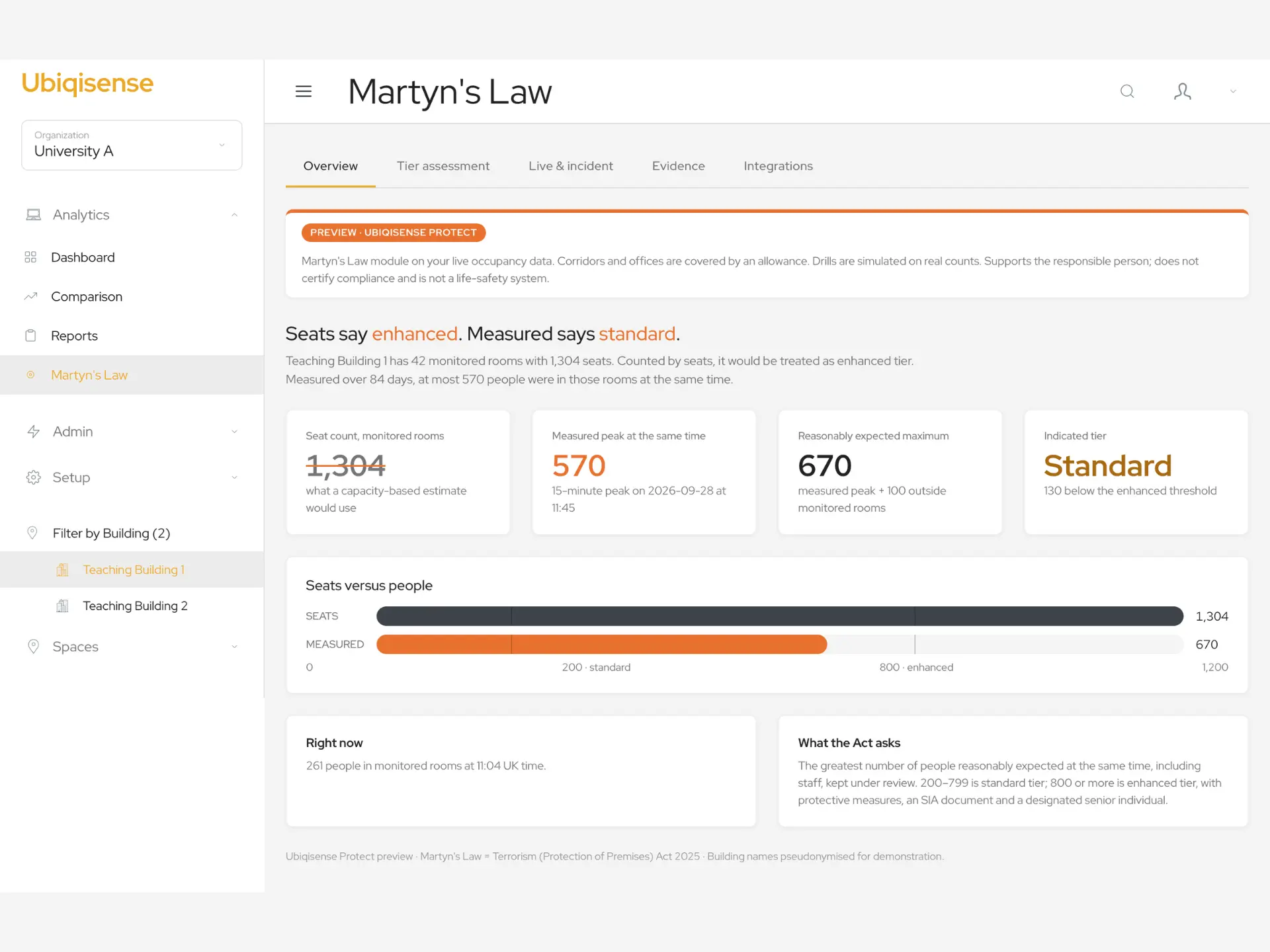
The building has 1,304 seats across 42 monitored rooms. A seat count would put it in the enhanced tier.
In the first 84 days of data collection, at most 570 people were in those rooms at the same time. The sensors cover the 42 rooms, but the Act counts everyone in the building, including people in corridors, offices, and toilets. Therefore, the university adds an allowance for those unmonitored areas, set at 100 people. Adding that to the measured peak gives a reasonably expected maximum of 670 people. That is 130 below the 800 threshold, which puts the building in the standard tier.
The university will keep collecting data and review the figure continuously, including during exam periods and open days.
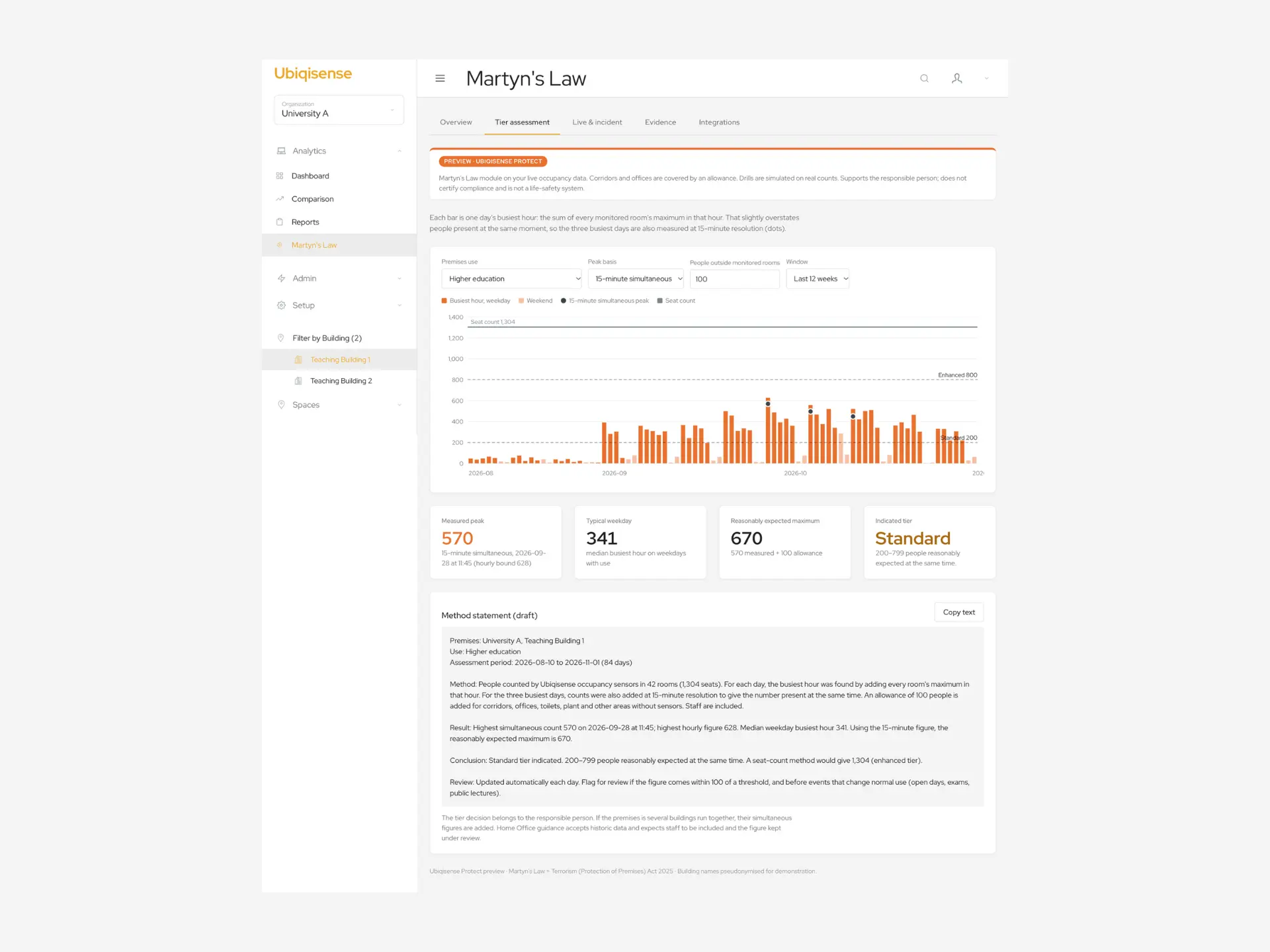
Ubiqisense sensors send occupancy data every 20 seconds. The platform charts each day's busiest hour, checks the busiest days at 15-minute resolution, and includes staff. It drafts a method statement covering the premises, use, assessment period, method, result, and conclusion. The figure updates daily and flags a review if it comes within 100 of a threshold, or before events like open days and exams.
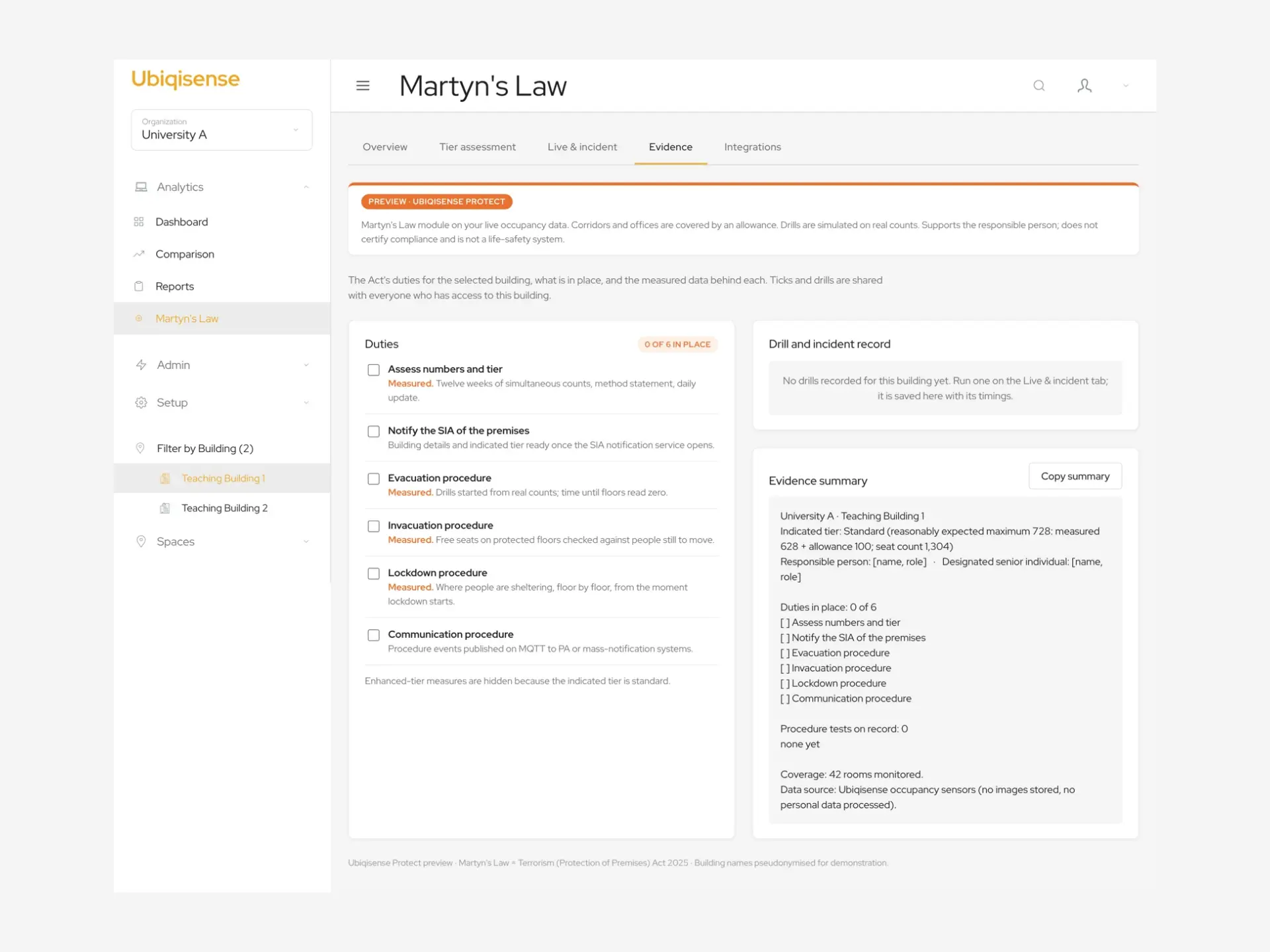
A checklist tracks each standard-tier duty: assessing numbers, notifying the SIA, and the evacuation, invacuation, lockdown, and communication procedures. Drills run on real counts, floor by floor, and are saved with their timings. An evidence summary pulls it together, ready to copy.
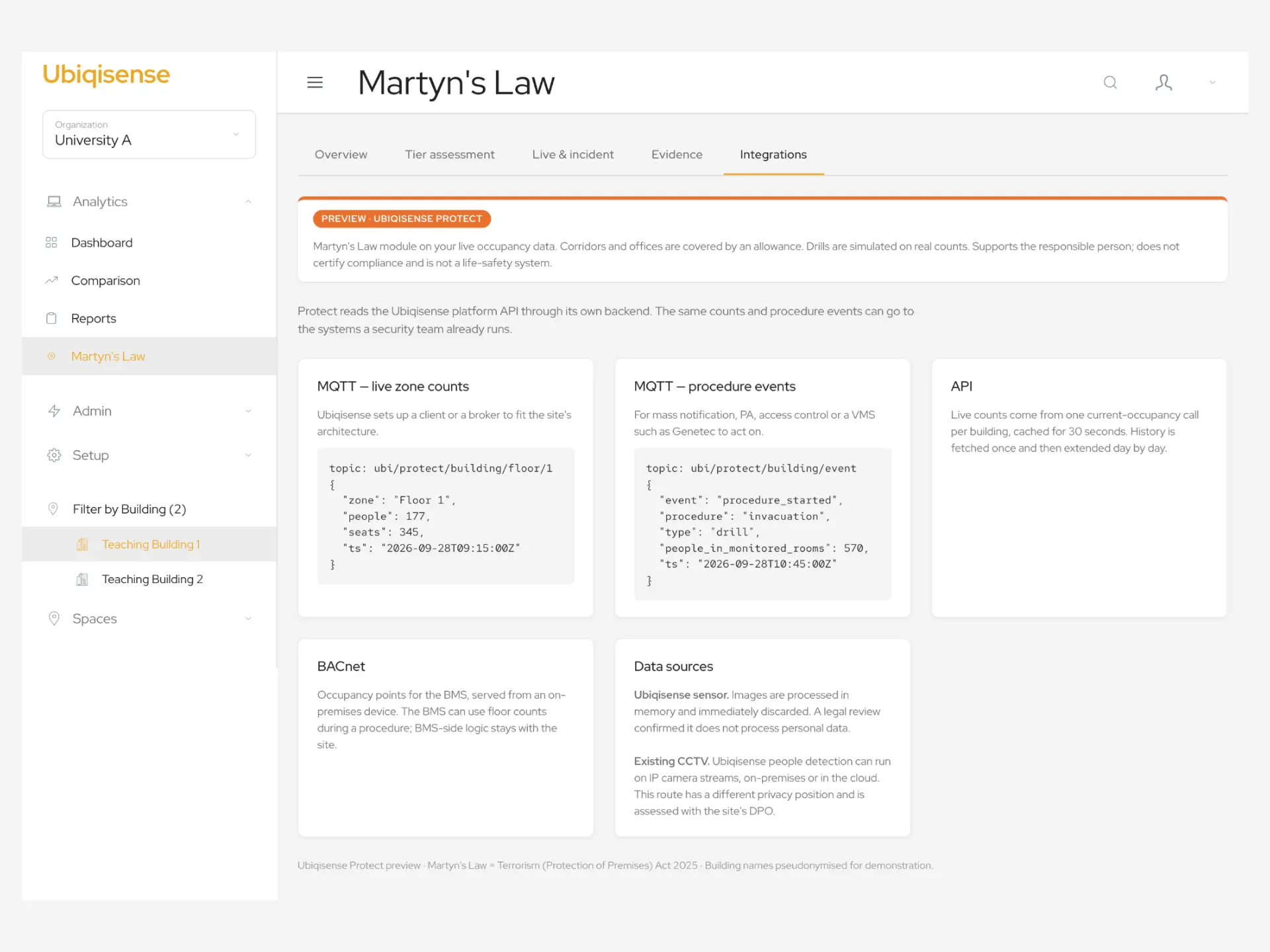
Ubiqisense consolidates data from your existing IP cameras, entrance counters, and other building data sources in one platform, with native occupancy sensors as the primary data source wherever you need real-time, room-level detail. You can send real-time occupancy counts and procedure events to your other tools over MQTT and BACnet, or through the API.
The Ubiqisense sensor does not collect personal data. It processes everything on the device and sends only anonymous occupancy data, such as people counts, positions, and timestamps, to the Ubiqisense platform.
Ubiqisense was founded in Denmark in 2016 and built the sensor to be GDPR-compliant from the start. It is also ISO 27001 and SOC 2 certified.
Since Ubiqisense is cloud-agnostic, data can be hosted on AWS in the region of your choice, or on Microsoft Azure, Google Cloud, a private in-country cloud, or fully on-premises.
Martyn's Law tiers are based on the people you can reasonably expect, not the most your building could hold. For many organisations with a fire capacity over 800, accurate data could show they belong in the standard tier.
We strongly suggest that you start collecting data now. With the main duties expected from spring 2027, data gathered from today would cover Christmas, Easter and the spring term before you need to notify the SIA. Keep collecting after that to complete a full year and confirm your tier at your first review.
This article is general information, not legal advice.
Find out how Ubiqisense can help you evidence your Martyn's Law tier.

