Request a demo
Fill out the form and
we’ll be in contact shortly

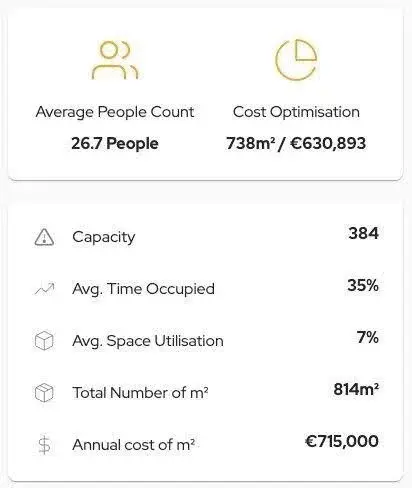
One enterprise client's office captures the problem precisely. The space was built for 384 people. On any given day, 26.7 were actually there. Space utilisation measured at 7%, with desks and rooms registering as occupied only 35% of working hours. Of the 814m² footprint, 738m² was flagged for right-sizing, representing €630,893 in identifiable annual savings against a total occupancy cost of €715,000. This is what underutilisation looks like inside a market that everyone describes as completely full. This is an extreme example, but without your own building data, you could be closer to these utilisation rates than you think.
That apparent contradiction resolves once you separate two numbers that get routinely conflated. Occupancy - the metric landlords, agents and market reports track - tells you whether a lease is signed. Utilisation tells you whether the person that lease was signed for is actually at their desk on a Tuesday. A building can be 98% occupied and running at 60% utilisation at the same time, and only one of those figures shows up on a rent roll. Across Ubiqisense's global customer base, 40% of leased space generates rent, energy and emissions without anyone in it on a given day. In the UAE, that gap is hiding behind a market that looks, by every other measure, completely full.
Dubai's office market entered 2025 already at near-capacity, with DIFC occupancy at 98% in Q1 and average rents up 45% year-on-year across 22 submarkets. By Q1 2026, Savills reported rents stabilising at AED 238 per square foot, the first quarter without further acceleration since the first half of 2021, framing the shift as a move from headline rental growth to occupier strategy. The market stopped getting tighter. It didn't get looser. Knight Frank put it plainly: prime stock is at near-total occupancy, and corporates are now consolidating into fewer, higher-quality headquarters because there's barely any new space to expand into.
Abu Dhabi tells the same story. Savills recorded record Grade A occupancy and rental growth through 2025, with CBD rents up 42% year-on-year and Outer CBD up 18%, and prime districts stayed landlord-led into Q4 with minimal new supply before 2027. Knight Frank's numbers align: Grade A rents up 28% year-on-year by Q3 2025. JLL's Q3 2025 read confirmed vacancy fell sharply across both cities, leaving the UAE office market landlord-favoured on both sides of the border(9). JLL puts prime Dubai vacancy at 0.3%. This isn't a market where a company can simply hand back the floor it isn't using.
Office size in the UAE isn't only a real estate decision, it's an immigration one. On the mainland, licensing authorities commonly work to around one visa per nine square metres, while each free zone sets its own ratio tied to leased office space, for example one visa per eight square metres in ADGM. A company's registered footprint is therefore sized to the maximum number of people it might sponsor, not the number who will be present on any given day. A business holding 100 visas needs roughly 900m² on paper – regardless of whether half those people work remotely, travel regularly, or are otherwise rarely in the building.
The gap between permitted headcount and actual attendance is structural, not temporary. And government policy is now pulling in two directions at once. Dubai's public sector employees receive remote-work allowances during Ramadan and participate in a four-day summer week pilot. Private sector firms are encouraged to follow, but carry no obligation to – and whether they do or not, the nine-square-metre formula that determines their registered office size doesn't move. A company can embrace hybrid working and still hold precisely the same lease, because the visa quota that anchors it is calculated on people, not presence.
This is what makes the UAE situation structurally different from most other markets. In London or Amsterdam, a company that shifts to hybrid working can negotiate a smaller footprint at renewal. In the UAE, the footprint is partly a function of how many people the company is authorised to employ. The path to a leaner, better-used office runs through measurement and redesign, not through giving space back.
That path starts with knowing what the space actually is. The regulation governs square metres, not how those square metres serve the people inside them. The same granular occupancy data that flags 738m² as redundant – which rooms, when, by how many people, for what kind of work is what makes it possible to redesign that space into something employees actually want to use: the focus rooms that don't exist yet, the collaboration areas people currently work around, the quiet zones that would make the commute worth making. The square metres stay on the lease. What sits inside them changes to match the people who actually come in.
Know your utilisation rate before your next renewal, not your headcount or your visa entitlement. How much space a company holds is a different question from how much of it actually works for the people inside it, and in a market this tight that choice holds for years.
Where the lease can move, occupancy data is the negotiating tool. Room-by-room, hour-by-hour attendance patterns make for a very different landlord conversation than a headcount estimate.
Where the visa quota holds the footprint in place, the data becomes a design tool rather than a cost argument. The question shifts from how much space to whether that space gives people a genuine reason to use it.
A space designed around how people actually work, rather than how a lease assumed they would, doesn't just reduce waste. It gives employees a better environment and a measurable reason to be in it, and that's the productivity argument the rent roll will never surface.